In food a math and science course, our second unit, Cooking, is focused on the chemical reactions behind cooking. This Action Project we had to change an original vanilla cupcake recipe to fit with Passover, which symbolizes a time when Jews had to change from eating certain foods including leavening agents. We had two different kinds of experiments, one was the control group, where we followed original recipe for a vanilla cupcake. The other group was the experimental group, where we had to take out the 1 most important ingredient. The ingredient that we had to take out was baking powder, which has both an acid, cream of tartar, and a base, baking soda. We learned about the pH scale and we tested the pH of different cooking ingredients to see how acidic or basic the ingredient is so we can substitute that in our cupcake experiment. My group picked olive oil (base) and lemon juice (acid). What I learned during this project was how you can switch out an important ingredient and find substitutes to replace it. What I am most proud of is how my experiment came out, and learning that I don’t always need a leavening agent to make cupcakes.
 |
| Photography AC Control Cupcakes 2014*
Lab Report:
Control and Experimental Cupcakes.
Introduction:
For this cupcake experiment my group chose to use olive oil and lemon juice to substitute for baking powder. Our reasoning for that is olive oil is a base and on the PH scale it has a pH of 8. Lemon juice is our acid which, on the pH scale s a 2.2. When acid and a base are mixed together, they neutralize the acid and base properties making salt, water and co2. Hopefully olive oil and lemon juice will react to help our cupcakes rise, we had to measure the height of the cupcakes to determine if they mimic the control cupcakes.
Research Question:
Will Olive oil and lemon juice help cupcakes rise, like baking powder does?
Hypothesis:
If we replace the leavening agent, which is baking powder with olive oil and lemon juice, then the experimental cupcakes will rise as high as the control cupcakes.
Materials:
1/12 cup of sugar
1/24 cup of butter
⅙ eggs
⅙ tsp of vanilla extract
1/48 cup of all purpose flour
⅓ tsp of baking powder (for control group)
1/24 cup of whole milk
olive oil and lemon juice (for experimental group)
For Control Group:
1.Preheat oven to 350 degrees F.
2.In a medium bowl, cream together the sugar and butter.
3.Beat in the eggs, one at a time, then stir in vanilla.
4.Combine flour and baking powder, add to the creamed mixture and mix well.
5.Finally stir in the milk until batter is smooth.
6.Grease or line a muffin pan.
7.Pour or spoon batter into the prepared pan.
8.Bake for 20 minutes.
For Experimental Group:
Preheat oven to 350 degrees F.
In a medium bowl, cream together the sugar and butter.
Beat in the eggs, one at a time, then stir in vanilla.
Combine flour and add to the creamed mixture and mix well.
Finally stir in the milk until batter is smooth.
Grease or line a muffin pan.
Pour or spoon batter into the prepared pan.
Mix olive oil and lemon juice into cupcakes one at a time.
Bake for 20 minutes.
Data:

The graph shows the height for both the control, and experimental cupcake trials.

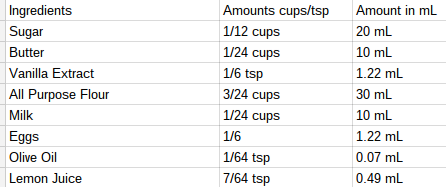
Recipe in Metric:
Conclusion:
From this experiment, I learned that it is possible to replace a leavening agent because in all six of my cupcake trials, my cupcakes rose. In conclusion my hypothesis was wrong because our experimental group cupcakes did rise as much with our replacement ingredients. The cupcake was 0.25 cm shorter than the control group cupcakes. All of our cupcakes were around the same height, except the 6th cupcake, which was 1.05 cm shorter than the control group cupcake. The reasoning for that is the batter is more basic than acidic. It had more, olive oil than lemon juice. I believe that the 5th cupcake was my favorite and the best out of all six cupcakes because it had more lemon juice in it, which made it taste really delicious. The cupcakes were a perfect golden brown on top and a dark brown around the edges. The outside was hard, while the inside was nice and moist. Overall I think the experimental cupcakes came out better than the control cupcakes did.
|
.JPG) |
| Photography JV Experimental Cupcakes 2014* |
