Pages

Monday, April 21, 2014

The Original?


During the first unit in the Humanities Food For Thought class I learned how and why humans gathered food; how they domesticated food; how food has changed over time; and how humans and food depend on each other. I learned that we are “walking corn.” I say that because we depend on corn so much. Corn is one of the first and most important foods that we domesticated because literally almost everything is made up of corn. This Action Project was to pick a vegetable or fruit and write an autobiography in first person. I pretended that I was cilantro. I also had to find a way to connect cilantro to my family’s food culture. I chose cilantro because it is mainly used in Mexican dishes and my family uses it a lot. What I learned about my family’s food history is that we mainly like Hispanic dishes because I am Mexican and Puerto Rican. Look at my family food tree that I created down below!


Created by JV "Family Food Tree" 2014*
Think of me as a leader of all spices, I am an original. My name? Well I am Cilantro, also known as Coriander, but that was a long time ago and I have changed since then. I have been used for over 7000 years, and I am one of the oldest spices recorded in history. I am from Southwestern Asia and I have been used by Egyptians and many other cultures. But Egyptians were the first ones to notice me. They used me as food in the afterlife for the departed which was alright, I guess. When the Israelites were freed from Egypt they spread me basically all over the world and changed my life. I was in the Middle East, Asia, North Africa, and Southern Europe. It was pretty amazing to be used in other countries and for different reasons. I wasn’t only used for the afterlife, which by the way sucked because I saw dead people and had to feed them - yuck! I was also used for medical reasons and as a culinary herb. People loved eating me raw, baked, and made into paste - you name it. I am also good for health reasons and I help body odor.

My flavor is fresh with hints of citrus, and believe me, I am strong! My specialty? Being used in Mexican food! My favorite dish to be mixed into is guacamole, which is also my family’s favorite. I know they only eat guacamole on special occasions, because I’m always made for holidays and I overheard them talking about how special I am. I love being made into a paste to spread over baked chicken. I am put into tacos for favor,and I am used in green juices, which are some of my owner’s favorites. I love to grow during the spring when it is 70 to 80 degrees. This weather is perfect for me and I enjoy the intense sunshine. I like to get my tan on.

In the United States, I am grown in California and Florida then, I get shipped to local grocery stores. Once I’m there, people will buy me like crazy and put me in many different kinds of dishes and I love it. I’m not only used on one side of the world anymore but everywhere. I would like to thank my creators, the Egyptians and Israelites, for discovering me and changing me. If I was never discovered I would have died off and wouldn’t be where I am today. Mexican food would basically be nothing without me. I give so much life and favor to so many dishes. People also wouldn’t be as healthy without me and let’s face it, they would smell really bad. My life has been full of flavor and I am so thankful to be a part of this world.

Sources:

“Brief History of Israel and the Jewish people”. science.co.il. 2014. Web. 15 Apr. 2014.

“Cilantro”. College of Agricultural Sciences. 2014. Web. 15 Apr. 2014.

“Herb Profiles: Cilantro/ Chinese Parsley/Coriander.” herbinfosite. N.D. Web. 15 Apr. 2014.


“Kitchen Dictionary: Cilantro.” food.com. N.D. Web. 15 Apr. 2014.

Tuesday, March 25, 2014

How may Deaf Culture become Mainstream Culture?

During the Experiential Term, we learned ASL and immersed ourselves into Deaf culture. We worked as a group to make a micromentary that answered a question that we were passionate about answering. We all had roles that we took on during this project. We learned how to work together and listen to each others ideas. What we are most proud of is how our micromentary came together. We worked really hard on it. Watch our video below!

  
How May Deaf Culture Become Mainstream Culture? from GCE on Vimeo.

We learned that as early as 1000 BC the Deaf were discriminated against due to their permanent loss of hearing and outrageous claims that deafness was a sign from God to show his anger towards humanity. In the eighteenth and early nineteenth century, there were very high limitations in educational opportunities for Deaf children in America. In the 1800’s there were about 30 deaf schools that opened across America. The Cobbs School, Alexander Graham Bell School and Gallaudet were the first schools to present curriculum based on oral learning and ASL for both educational and cultural purposes. 

We watched Sound & Fury a documentary following a 5-year old girl with the desire to learn spoken language by getting a cochlear implant. Her parents were deaf and proud members of the Deaf community and feared losing their daughter to the hearing world. This showcased the struggles of being a member of both the Deaf community and the hearing world. There is much controversy surrounding cochlear implants which is believed to be a cure to deafness. This technology is controversial because it threatens the survival of the thriving Deaf language and Culture. 


Today, it is easy to see the importance and prominence of Deaf culture in schools, sports, and Art. We visited the Children of Peace School in Chicago that focuses on integrating hearing and deaf education. We were surprised to see hearing, hard of hearing, and deaf students learning in the same classroom. We also attended a basketball torment for the Deaf where Deaf teams from as far as Boston competed for the title of champion. I was in awe by how highly athletic these players were and how everyone knew each other. We witnessed the same type of talent and friendship when we watched the documentary Deaf Jam, which showed a group piece performed by Aneta, a Deaf poet and Tahani a spoken word poet .

Monday, March 24, 2014

Learning a new language!


During Experiential term, I took a class to learn ASL and to understand deaf culture. I learned basic ASL and heavy information about DHH. I learned about cochlear implants and how they are not a cure for deafness, as many people believe. I learned how to make a micromentary and work with a group and see different opinions. What I am most proud of from this term is learning and practicing ASL. I am also proud of opening up more, I think ASL helped me with that because I learned communicating with everyone is important. Being shy won’t get me any where and I know when I open up people like to see how I act.


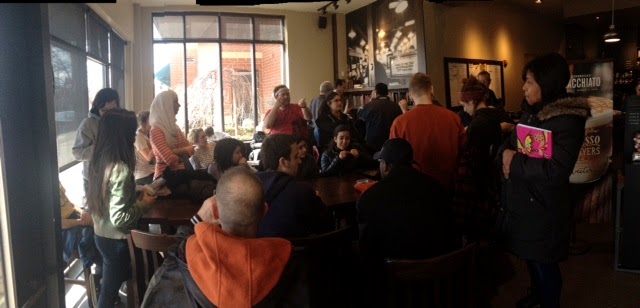
Photography JV Starbucks ASL Meet up 2014*
I went to a sign language coffee chat in Evanston at Starbucks Evanston (519 Main St, Evanston, IL 60620). I went with my classmate RD and her aunts. Most of my other classmates went as well. It was nice because we were all together and when we didn't understand a sign that someone did we will communicate with each other to figure out what they were saying. It was nice meeting older DHH members, to communicate with them using ASL. I like how all the members were so open and nice to us. They taught us new signs. They said that it was great that we were taking a term to learn sign language and we should practice more so we can become fluent. I also saw people with hearing aids and with cochlear implants. Overall, I think the meet-up went well. If there is other meet-up I will definitely go again!

This term changed my view because I did not know that ASL was a language. It also changed my attitude towards the DHH community because I did not know anything about the culture. I have never really seen members of the DHH community until now. My ASL teacher was the first deaf person I ever meet. I learned so much from this term and I appreciate the DHH community. During our visit to Mt. Sinai Hospital, we met a team of Deaf  Therapists. This most inspiring to me because I got to learn more about deaf culture. I learned what it is like to be deaf, and to hear stories about deaf people. I really liked hearing one of the therapists telling her story on how she became deaf. It is really interesting to hear that so many people become deaf at such a young age from being sick.

Thank you, Deaf therapists at Mt. Siani for teaching me more about deaf culture. Thank you for answering all our questions, I learned so much. I learned more about cochlear implants and how it doesn't’ work for everybody. I learned that some deaf people aren't born deaf but can become deaf from sickness. I want to thank Vivian for sharing your story on how you became deaf.

My two roles on the micromentary team were to take pictures and to edit the video. I was successful in my roles by paying attention, getting my work done, and being on top of everything. As the editor, I made our micromomentary come together. I am most proud of learning how to use iMovie. I like how my team worked together to get pictures and videos to make the micromentary come together. The main lesson I learned from from making the micromentary is captioning it. I think that is really important for the DHH community so they can understand what our video is about. I think that is important for every program on television so deaf people can be apart of the hearing world too. Working in a team was interesting, I learned that working together can be hard because people go at their own pace. We all had different ideas, and different ways of viewing things. We will have to experience what that person goes through on a daily bases. We will have to feel how they feel and see what they see. We did that this term we experience what being deaf is. We felt how not understanding a different language is hard, just like DHH members don’t understand English. We had to step in their shoes to feel how being uncomfortable is when not understanding a language and having to go through that for one month but for DHH members it can be their whole life.


Sunday, February 23, 2014

Slowly dying!


The purpose of this Action Project was to find the carbon footprint that I create with my lifestyle. I also had to find three actions to reduce the carbon that I put in the atmosphere, and in order to show this information, I created a diagram that shows all of the actions I will take. This also relates to one of the Field Experiences that we went on during this term. We went to the Robert W. Galvin Center for Electricity Innovation, and we learned how they power their whole community with renewable energy. They talked about how renewable energy is going to be big in a few years. I think that is eye-opening that one part of Chicago is already taking steps to try to save our Planet. Just as the Galvin Center is trying to take steps to save our Planet, I am sharing my action plan below, so that even individual people can make a difference. The challenging part of this Action Project was getting my carbon information. What I found most interesting was how much carbon I actually put into the atmosphere. I was surprised by the information, because I produce a lot of carbon, so imagine how much the whole world produces. What I am most proud of is how my essay came out because I think I have good information for people to go off of.

Created by JV 2014*
Pollution is the introduction of contaminants into the natural environment , which cause adverse change. Pollution can be released into the atmosphere by breathing, gas being given off from livestock, burning fossil fuels, volcanoes, and fracking. Most of these pollutants are man-made, and the only way to stop it is for us to change the way we live.

Carbon dioxide is one pollutant that is warming the Earth’s atmosphere and dramatically changing our climate. My individual information will provide some reasons why this is happening. According to the “Footprint Calculator,” I release about 22.1 tons of carbon dioxide into the atmosphere. High levels of carbon are affected by the food I eat, shelter, mobility, and goods. My lifestyle is being supported by 23 global acres of Earth’s productive area, and if everyone lived like me, we would need 5.2 Planet Earth’s to provide enough resources.

My lifestyle is equal to the same amount of greenhouse gas emissions as 4.2 passenger vehicles, while my carbon dioxide is equal to 2,248 gallons of gasoline consumed. That is a lot of vehicles and gasoline for one person, so can you imagine the world living like me? We would not have an Earth to live on!

In order to reduce my carbon footprint, I will have to change my lifestyle so that I can produce less carbon annually. I pledge to:

  • Reduce the amount of animal products I currently eat by half. I frequently eat beef, chicken, and dairy. Livestock such as these release the greenhouse gas methane into the air. By reducing the amount or animal products I eat by half, I will reduce the number of Planet Earth’s by 0.4! ( from 5.2 planets to 4.8). This will reduce my CO2 emissions from 22.1 tons to 21.4 tons. 
  • Purchase products that use less packaging or made out of 100% post-consumer recycled content material. As waste decomposes, it produces methane, which increases global warming. By reducing waste and recycling, I will reduce the number of Planets Earth’s by 0.7! (From 4.8 to 4.5 planets). Recycling will reduce my CO2 emissions from 21.4 tons to 18.6 tons!
  • Switch to solar panels for electricity in my home. By switching to solar panels that give pure energy from the sun, I will help to combat greenhouse gas emissions and global warming and reduce fossil fuels. I will reduce number of Planets Earth's by 0.2! (From 4.5 to 3.9 planets). Using solar panels will reduce my CO2 emissions from 18.6 tons to 16.4 tons!

Even if I follow with all of the actions listed above, I cannot eliminate my carbon emissions completely. Another way I could offset carbon from my lifestyle is to invest in an emissions reduction project that will capture and store greenhouse gases, preventing their release into the atmosphere. To eliminate carbon that I produce, I would have to plant 514 trees and here is why: Scientists have found that 1 urban tree will remove 0.039 metric tons of carbon from the atmosphere. As mentioned previously, I produce 20.1 metric tons of carbon annually. If we use the conversion formula, we find that it takes 514 trees planted to remove 20.1 metric tons of carbon.

20.1 metric tons (1 tree/0.039 metric tons) = 20.1/0.039 = about 514 trees.

By taking these actions listed above, I would reduce my carbon footprint from 5.2 to 3.9 planets. In terms of carbon, it would decrease from 22.1 tons to 16.4 tons. That is 4.7 tons less carbon in the atmosphere. I would make the world a cleaner place if I follow through with my three actions. I would need to plant 514 trees to remove these emissions. All of these actions will be challenging, but I am willing to try, because we need to reduce our carbon ppm from 400 to 350. If we don't, future generations will not be able to survive in such a polluted climate.


Work cited:

“Air pollution.” National Geographic. 1996-2014. Web. 16 Feb. 2014

“Clean Energy: Greenhouse Gas Equivalencies Calculator.” U.S Environmental Protection Agency. n.d. Web. 14 Feb. 2014.

“Footprint Calculator.” Global Footprint Network. Sept. 2011. Web . 14 Feb. 2014.

Thursday, February 20, 2014

Till I see you again.


The purpose of this Action Project for my Humanities class, Who am I? was to find a important dream and analyze it for its meaning. My dream was about my grandfather and how he is sending me a message. The most challenging part about this Action Project was writing about my grandfather. What I am most proud of is my dream catcher, it means a lot to me and I love how it came out. 

Photography JV PEACE 2014*
The center of my dream catcher symbolizes peace and love. I want my life to be full of happiness and my bliss is anything that I love doing. When I am asleep my unconscious sends me messages in the form of dreams. I want these dreams to lead my life in the right direction. In the middle of my dream catcher is a heart to symbolize my love for my family. The colors of my dream catcher is mainly light neutral colors. I chose colors like that because they make me feel calm and safe. I wanted the center of my dream catcher look like a star because I really like how that design looks. The star has six points and I put 6 beads in the middle. The points of the star and the beads symbolize the number of people in my family. The six feathers represent my family that I want each member of my family to be safe.

Photography JV PEACE 2014*

I attached a 6” dream catcher on the bottom of the 8” one to symbolize my grandfather because I feel like he is still with us, and he watching over my family. For his dream catcher I put 15 beads representing his children and grandchildren. To symbolize negative elements I tied knots in my dream catcher, I did that to show struggles that I have in my life. I want my dream catcher to filter anything that may repress my desires.  
                                                                                                            
                                                                      Photography JV PEACE 2014*

The dream that I had that inspired me to make my dream catcher was about my grandfather. He had passed away and that same night I had a dream about him. He was wearing all white and told me not to be sad anymore, for my family not to worry that he is fine and he is okay now. He said to be happy and that we will all see him again soon. 

If I could go back to the dream, then I would ask my grandfather some questions. I would ask him why did he only reach out to me? I would ask him if he was okay. And If I ever had this dream again, then I would want it to last longer. I would want to talk to my grandfather and tell him I love him. What I learned about dreams during this project, is that people can have similar dreams. My boyfriend and I both had dream about a relative that we care about that had passed away. I also learned that dreams can send you messages, that you don’t even realize. I think that that is really interesting because dreams can tell you your future or what will happen.

Tuesday, February 11, 2014

Who Are You?


The purpose of this action project in the Humanities class Who am I? was to come up with a guiding question that can guide my life. My Guiding Question is Who are you? I came up with this question because I think a lot of people think about this in their lives. What was most challenging was coming up with a guiding question because I didn't want mine to be too confusing. What I am most proud of is how my essay came out. I think it is really interesting. I will like to grow as a writer, that is why I chose to write an essay rather than doing a slide show. I hope my guiding question inspires you to find out who the people in your life are.


                        David Brooks. Who You Are then What You Do28 May 2012. Internet: SWiVELtime.com. 10 Feb 2014.

Who are you? On the Truman show, Truman Burbank was a real life reality TV star not knowing who he was. Truman became suspicious of his perceived reality and embarked on a quest to discover the truth about his life . Truman’s wife did not love Truman because she was an actor, she was just a part of the play. While, one of the actresses on the show, Sylvia, who really did care about Truman was kicked out of Truman’s world (The Truman Show) for attempting to tell him the truth about his reality. She made Truman think about his life. What if the people that come in and out of your life are like Sylvia? What if they were kicked off the show because they were trying to tell you that your life was fake? Who are the people in your everyday life? Do you think the people in your life care about you? Or are they all actors? Are you part of the Truman show?


I want you to think about the people in your life. Do you ever have scruple about the idea of people being real to you? Perception allows you to see the people around you in different ways, how do you know if people are lying? How do you know what people really want from you? How do you know if someone is sincere? A psychiatrist can help a person with paranoia, and offer that person medication and weekly meetings to help them understand the people in their life. A social worker can help people overcome trauma or past experiences and help them perceive the world in a different way. They can also tell you to meditate. Which is to calm your body and mind, to be at peace with yourself. 


WHO ARE YOU? Do you doubt who you are? What do the people in your life want from you? What do they expect? Do the people in your life truly love you do they care about your feelings? Do they care if anything will happen to you? This question is important to me because I think I know the people in my life. Or are they all lying to me? What risks will you take to find out? I would examine people around me at all times. I know many people around the world have the same question. This goes for all humanity because we need to know the people around us. We do not know when people are lying or if they are telling the truth. The people in your life can be like Truman’s wife they can just act like they love you or care about you. Is someone watching your life? Are you on the other side of the TV? Is every single person in your life true to you? Have you ever taken any risks to find out? Have you ever look around you to find out who you are?

Wednesday, February 5, 2014

Solar Panels


The purpose of this Action Project was to research a type of renewable energy that a home owner can switch to. I picked solar panels, which are a type of radiant energy because solar panels absorb the sun’s rays. I chose to do this type of renewable energy, because I think solar panels use more recent technology, and I love how we are constantly trying to further develop our technology. I like how we can get energy from the sun. To present my findings, I created a video that encourages viewers to switch to renewable energy. What I found most challenging about this Action Project was inserting pictures that match the audio portion of my project. I overcame this challenge by doing research about solar panels to understand them better. I am most proud of my video, because I think viewers will recognize the importance of switching to renewable energy. The video will help spread the word of how to make our planet cleaner and last longer. I also really like how all the pictures came together! 

                                                                                     Created by JV & RD

JV- Man my electricity bill has been going up! I need to make a change. Any suggestions? I just realized that buying light bulbs and wasting energy on light can really effect the earth and my wallet!

RD- Funny that you brought that up, because I just recently lowered my electricity bill. It’s something that I would have never thought I would switch to, but I’m using Solar panels now.

JV- Solar panels, What are those?

RD- Solar panels are designed to absorb the sun's rays, a type of radiant energy. They serve the purpose of transferring the heat energy from the sun to electricity for your home.

JV- I'm sorry I still don’t understand, and how does that benefit my wallet? 

RD- Solar energy is produced by conducting the sun’s radiation, a process that excludes any smoke, gas, and other chemical by-products. It does not need expensive raw materials like coal and oil, and it requires a way lower operational labor than normal power productions.

JV- So your saying if I buy these Solar panels, I will save money and live a healthier and less expensive life?

RD- I sure do! How much are you paying right now, for your electricity?

JV- I am paying $105.20 every month.

RD- Wow! Exactly what I used to pay.

JV- I mean, I’m hearing some good things about these panels, but there has to be at least another downside to them, besides the price right? 

JV- For example, do I get any light in the night?

RD- No. However, if the previous day was full of sunlight, your panels will collect that energy and save it for cloudy days or at night. Other than that, the only problem is that the sun doesn't shine 24/7.

JV- Okay where would I be able to buy these solar panels?

RD- I got mine at Solar panel warehouse, for a pretty good deal! Plus they install them for you, but for a steep price.

JV- What’s the initial cost? And will I break even? If so, when?

RD- You typically use 513 kWh in any given month, which means you are paying $23.78 per kWh for electricity in a single month. This is known as your electric supply charge, and its really high! Basically, at this rate, you are paying $105.20 each month just for electricity.

RD-If you were to install Solar panels, initially, it will cost you $8,000. I know that is a high cost, but if you wait 9 years, you will break even, and your investment will pay itself back in cash. Over 14 years, your annual average utility savings will be anywhere between $1,930 to $3,682!

JV- WOW! I am totally switching, thank you for the information!