Pages

Wednesday, September 17, 2014

Mexican Mole Lizard.

The purpose for this first Action project for my STEAM class called "Population", which is a Global Health series that talks about why our population had changed throughout history and what this means for our future. During this unit, I learned both Mathematical and Scientific systems of classification; I also learned about Taxonomy, which is the branch of science that classifies animals, which helped me a lot with my project. I picked the Mexican Mole Lizard (Bipes biporus) because it looked so interesting to me, and how it's one of a kind because it doesn't have a relative. The MML is cold blooded, its Bipes because it is a Carnivore and Squamata because it has scales. Using Taxonomy helped me a lot because I got to see what class my animal was in as well as other information. What I found really helpful with doing this AP was really understanding what Taxonomy is. What I found challenging was doing the Mathematical language because I'm not that great at it, but I would love to improve. What I enjoyed about this project was learning about all different kinds of animals.

Here is the Taxonomy classification of the Mexican Mole Lizard.

Kingdom: Animalia
Phylum: Chordata
Class: Reptilia
Order: Squamata
Family: Bipedidae
Genus: Bipes
Species: B. biporus

Created by JV, "MML" 2014*
Here are the set theory statements explaining in mathematical language what my animal is categorized in and what it's not.

Created by JV "MML" 2014*
Here is a three circled Venn Diagram, I compared my animal with my classmate RD who had a Blue Tailed Skink, and my other classmate AMK had a Fennec Fox. To see what we have in common or what we don't have in common.

Created by JV, RD, AMK 2014*

Monday, June 2, 2014

Food Production.

In the last unit of Food for Thought, our humanities course, we were assigned to team up in four groups to demonstrate the understanding of our four units in pictures. The main points of the whole drawing are agricultural history, and to envision a sustainable future of food production. Each group had to have 3 topic points to demonstrate in the drawing. My group was assigned the first unit which was Life. This unit talked about the beginning of agriculture and ancient civilization and how different foods were found and domesticated. For inspiration the whole class looked at a very interesting piece of artwork done by "The Beehive Collective," called the "True Cost of Coal." The major challenge of this drawing was to connect all the units together through different styles of artwork. The other challenge was thinking about the future of food, with all the experiments that scientists do with food, is there really a bright looking food production ahead of us? 
Created by JV, DR, NVA. Unit 1, 2014*
This drawing is based on the first unit, called “Life.” The main focus of this unit is how and why humans transitioned from hunter-gatherers to agrarian societies, and how different ancient societies domesticated and found food. In my group, we decided to make a road timeline to connect all the units together. For our unit, we drew an assortment of different foods on the road. The reasoning for this is to symbolize how people grew crops to survive. There were no chemicals or fertilizers, so societies grew organic gardens. In 10,000 B.C.E, people were hunter-gatherers, which means they hunted animals and fish support their diet.

We drew trees and plants on one side of the road to represent life and peaceful times. We used keywords to guide our drawing. We used organic, domestication, and life. On the other side of the road we drew trees and plants to represent life. We also drew hunter-gatherers to show them hunting for food, and how they lived a natural lifestyle. We showed the society by water and we showed the people farming and hunting. 


The beginning of agriculture is where the word “life” comes from. We wanted to show in our drawing, how our ancestors settled where they did and how they domesticated their foods. The importance of this unit is vast and it all comes together since this is the first of four units. Unit 2 revolves around monoculture, death, and colonization. Unit 3 revolves around this world’s food industry and the way that our food is made and treated today. Unit 4 revolves around the modification of the food industry and how life has transitioned through all 3 units, and imagines what the future of food might look like.


GS. Food for Thought 2014*

Friday, May 30, 2014

Anti GMO!

In the last unit of Food, an integrated math and science course, we studied plant genetics and genetic engineering. For our last action project, we had a debate whether to allow GM seeds in our rural community in Illinois. I am anti GMO because I believe in letting nature be itself. GMOs change nature’s habits, making food not natural or organic.The USDA approves GM seeds but have not included the after effects of GM foods on our bodies. This is scary because we have no idea what GMOs can do to us in the long run. One Field Experience that I went on during this term I visited an organic farm. That experience really opened my eyes and made me more proud of eating healthy. I will definitely shop at farmers markets this summer to support local and organic produce. What I am most proud of is my argument. I think they are really strong and will give people something to think about!


What would you rather have? A tomato that has been injected with fish DNA to last longer, which is a GM tomato or an organic tomato to put in your dinner pasta? Well I would rather have the organic one because it is so much healthier. We eat GMOs every day. It is basically in everything. Wouldn't you want to change that? Wouldn't you want to know where your food comes from, and what's in it right? I am just saying that organic is a better option. I know it can be expensive but it is so much better for your health, and you won’t be eating different organisms at once. You will be eating wholesome vegetable and getting the nutrients that you need. Trying to make food “better” when scientists are just making food worse, by adding so many chemicals and sugar. Food should be left alone with nature. Scientist are doing all theses experiments. They don’t know what could happen in the future, GMOs can cause so many problems. I am pro organic seeds. I chose this position because I think mixing foods together is wrong. Coming up with different ways for food to last longer is so wrong because that is causing people to become sick. I do accept that GMOs are in everyday foods that we eat and provides other foods, but I do think there should be another option. That option is to ban GMOs from the United States. My reasoning for that is scientist are getting out of hand with all of these experiments making food into chemicals.

 My classmates and I went to an organic farm, where we met a farmer, Marc, who practices organic farming. He states, "GMOs are bad, we do not approve putting chemicals in our fields. It is not right to change nature.” Marc does not believe in adding fertilizers, which kills nature’s habits. Nature gives us such beautiful and healthy foods so why change them? Marc eats healthy every day because of his organic farm. His body is clean and he saves a lot of money by not going to the grocery store as often. He is also outdoors a lot working on his garden, getting vitamin D and enjoying nature. Not only is he eating healthy and getting vitamins, he is also building physical, and mental health. Gardening burns so many calories, Marc is getting so many benefits by just having one thing. That is an organic garden.

 Eating healthier, and the highest quality of vegetables keeps your body clean. Organic vegetables have more taste and also more nutrition. It can help with body growth and can help your brain grow as well. It can save lots of money if you plant your own organic garden. It gives families a hand on supply of fresh foods.Being Outdoors, will do more for your mental and physical health. It can give your body vitamin D and can help maintain bone mass. It will also give you more activities to do rather than sitting inside with the air conditioning on or the heat, which can cause headaches and dizziness because of natural gas that controls them. Being outdoors will be better than in a lab testing foods to last longer or taste better. People sit all day trying to change good healthy foods adding chemicals and putting different types of DNA in the foods. 

Getting Exercise, each garden task can burn 200- 400 calories per hour. Over a six month growing season, a gardener can burn 35,000 calories enough to lose 10 pounds. Working the arms, legs, and abs all at once! This can help with a humans mind and making them more active! It will also provide a care for the environment for organic farmers. They start to see what natural can provide healthy and fresher foods, that GMOs cannot and take better care of it. GMOs can make lots of food, to travel from country from country without going bad. This could help developing countries, which malnutrition is a big problem adding vitamins to other foods can help save over 2 million lives, and to prevent becoming permanently blind. With that I think there should be another option, in developing countries should be a organic garden, a local place where different villages can have local and fresher foods, that doesn't have so many chemicals in it. That can save so many lives and make people healthier. People in the villages can also have jobs to support families and different organic groups can help support with seeds and money.

 My brother eats chips, lunchables, candy, foods that a regular seven year old would eat. The down side to that is he is getting hives every time he eats those types of foods. He is allergic to a chemical that is in junk foods. It is sad to see that because now we need to give him foods that cause the hives so we can see what foods he can’t eat. Since he has stopped eating junk food, he is now eating organic and healthy foods. We can see the difference. He has more energy. He is happier. And his skin looks glowy and healthy. This is a big reason why scientists should stop their experiments. To stop this from happening please vote for NO More GMOs in our community!

Monday, May 26, 2014

Quality vs Quantity.


During this last unit called Birth, I learned about how technology influences what and how we eat since the Industrial revolution, which improved technology and transportation with food. I also learned about fresh vs industrial food, fast food companies and how they control over half of our dairy and meat products. For this last Action Project I had to determine whether there is a difference in taste between fresh and processed food. I chose to eat at Panera bread, which I think is an okay fast food restaurant. When I made my homemade meal it was fun to make something different. I made the dish for lunch for my Mom and I, which I usually do because I like to cook a lot. This unit has changed how I think about food. It influenced me more to eat healthier, which I have been doing for a little over 6 months now. I really love to keep my body healthy and watching what I put in it as well. I like to eat a lot and try different foods, but the more you eat healthy the more you will feel better, and notice a change. Over all I really enjoyed this whole unit, it taught me so much!


Photography JV "Panera Bread" 2014*
The restaurant that I chose to eat at was Panera Bread. The reasoning for choosing this restaurant was because I think the food is not as bad compared to other fast food restaurants. The dish that I chose was the Mediterranean Veggie sandwich because it is one of my favorites at Panera Bread. Once the dish arrived at my table it smelled like basil, onions, and cucumbers. The appearance was bright and colorful. It looks like a summer dish and really full with all the vegetables in it. When I picked up the sandwich to take a bite, the soft slightly toasted bread touched my fingertips. As I was taking my first bite, I instantly tasted the hummus, which was sweet, yet bitter, and a little spicy. The vegetables were crunchy as they hit my tongue, feeling cool and a little damp making a loud noise while chewing. The dish appeared fresh because the vegetables were still wet and had water drops on them, but the sandwich looked really perfect and clean.

My homemade dish, however, was completely different. I switched up the recipe a little when I made the homemade version. Instead of using basil bread, I used 100% whole wheat bread that was USDA Organic, which means the bread is made with 100% organic ingredients. I spread basil pesto and hummus inside the slices. I used my taste and visual senses I saw a lot of color, so I tried using that while making the sandwich. I used cucumber, red onions, spinach, tomatoes, and a yellow bell pepper. The sandwich came out really good, and tasted just like the Panera one. The sandwich was really colorful and bright. It was also really compacted with all the vegetables that were in it as well. It smelled like basil, that smelled spicy; cucumber that smelled sweet; and the onions, that smelled bitter. The texture of the bread was soft, while the texture of the veggies in the sandwich was crunchy and a little damp. While eating the sandwich it made a lot of noise while chewing, because of all the vegetables that were in it. The sandwich was also bitter, yet sweet, and a little spicy cause of the red onion.


Photography JV "Homemade" 2014*
The sandwich is small but it fills a person up so fast because it is filled with vegetables. The sandwich relates to a Michael Pollan's reading that my classmates and I read in class, when he talks about how fast food is quantity vs quality and how people over eat too many bad foods. I think my sandwich is definitely quality vs quantity, because the veggies that are in the sandwich has so many vitamins and nutrients that our body gets fuller so much faster. That makes us not want to eat so much because we are eating a lot of greens. If we are eating high quality of foods, we won't need to eat a high quantity of foods. I think that people should keep this in mind, because eating healthy and right is so much better for your health, rather than eating fast food with no limits, which causes high blood pressure, obesity and heart disease. I think that people should realize that fast food isn't really food, it is actually food science that is made by scientists. Scientists make those kinds foods so customers can buy them. Industrial food is made with loads of sugars, and salt, which your body would want more of. That is why people have cravings for bad foods. I know that fast food is easy and cheap and can taste good, but it is really bad for your body. Try to cook good and healthy homemade meals, that taste better than eating out. Then fast food can be more of a treat once every few months rather than eating it weekly. 

Overall I would recommend the homemade sandwich, because it is super easy to make and cheaper than buying it at Panera Bread. Most of the ingredients will probably already be on hand, and it is also really healthy and tasty. The organic bread that I used had a lot of fiber and vitamins, rather than the basil bread that has more sugar and salt in it, and less fiber because it is white bread. The homemade sandwich is really different and gives your taste buds something different to try which is nice. 

Monday, May 12, 2014

Vanilla Cupcake Experiment.


In food a math and science course, our second unit, Cooking, is focused on the chemical reactions behind cooking. This Action Project we had to change an original vanilla cupcake recipe to fit with Passover, which symbolizes a time when Jews had to change from eating certain foods including leavening agents. We had two different kinds of experiments, one was the control group, where we followed original recipe for a vanilla cupcake. The other group was the experimental group, where we had to take out the 1 most important ingredient. The ingredient that we had to take out was baking powder, which has both an acid, cream of tartar, and a base, baking soda. We learned about the pH scale and we tested the pH of different cooking ingredients to see how acidic or basic the ingredient is so we can substitute that in our cupcake experiment. My group picked olive oil (base) and lemon juice (acid). What I learned during this project was how you can switch out an important ingredient and find substitutes to replace it. What I am most proud of is how my experiment came out, and learning that I don’t always need a leavening agent to make cupcakes.

Photography AC Control Cupcakes 2014*


Lab Report: 

Control and Experimental Cupcakes. 


Introduction: 

For this cupcake experiment my group chose to use olive oil and lemon juice to substitute for baking powder. Our reasoning for that is olive oil is a base and on the PH scale it has a pH of 8. Lemon juice is our acid which, on the pH scale s a 2.2. When acid and a base are mixed together, they neutralize the acid and base properties making salt, water and co2. Hopefully olive oil and lemon juice will react to help our cupcakes rise, we had to measure the height of the cupcakes to determine if they mimic the control cupcakes. 

Research Question: 

Will Olive oil and lemon juice help cupcakes rise, like baking powder does? 

Hypothesis: 

If we replace the leavening agent, which is baking powder with olive oil and lemon juice, then the experimental cupcakes will rise as high as the control cupcakes. 

Materials: 

1/12 cup of sugar 

1/24 cup of butter 

⅙ eggs 

⅙ tsp of vanilla extract 

1/48 cup of all purpose flour 

⅓ tsp of baking powder (for control group) 

1/24 cup of whole milk 

olive oil and lemon juice (for experimental group) 

For Control Group: 

1.Preheat oven to 350 degrees F. 

2.In a medium bowl, cream together the sugar and butter. 

3.Beat in the eggs, one at a time, then stir in vanilla. 

4.Combine flour and baking powder, add to the creamed mixture and mix well. 

5.Finally stir in the milk until batter is smooth. 

6.Grease or line a muffin pan. 

7.Pour or spoon batter into the prepared pan. 

8.Bake for 20 minutes. 

For Experimental Group: 

Preheat oven to 350 degrees F. 

In a medium bowl, cream together the sugar and butter. 

Beat in the eggs, one at a time, then stir in vanilla. 

Combine flour and add to the creamed mixture and mix well. 

Finally stir in the milk until batter is smooth. 

Grease or line a muffin pan. 

Pour or spoon batter into the prepared pan. 

Mix olive oil and lemon juice into cupcakes one at a time. 

Bake for 20 minutes. 

Data:


The graph shows the height for both the control, and experimental cupcake trials. 


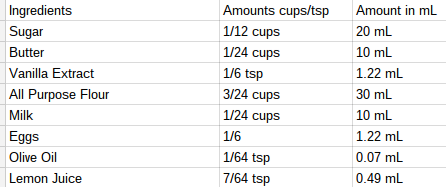
Recipe in Metric: 


Conclusion: 

From this experiment, I learned that it is possible to replace a leavening agent because in all six of my cupcake trials, my cupcakes rose. In conclusion my hypothesis was wrong because our experimental group cupcakes did rise as much with our replacement ingredients. The cupcake was 0.25 cm shorter than the control group cupcakes. All of our cupcakes were around the same height, except the 6th cupcake, which was 1.05 cm shorter than the control group cupcake. The reasoning for that is the batter is more basic than acidic. It had more, olive oil than lemon juice. I believe that the 5th cupcake was my favorite and the best out of all six cupcakes because it had more lemon juice in it, which made it taste really delicious. The cupcakes were a perfect golden brown on top and a dark brown around the edges. The outside was hard, while the inside was nice and moist. Overall I think the experimental cupcakes came out better than the control cupcakes did.

Photography JV Experimental Cupcakes 2014*


Wednesday, May 7, 2014

The Travel Of Tea.

The purpose of this Unit, Death, was to learn about our global food system by tracking the distribution chain of a specific food. We also had to make a Prezi to feel like we are actually traveling with the food. The food that I choose was Tazo Green Tea. I choose tea because I love it, and I drink tea every morning. An interesting fact that I learned about Tazo tea is that Starbucks owns it. What I enjoyed most about this unit was learning so much about the food chain, where different types of foods came from, and how food is processed. I used to wonder why there were apples in the middle of winter and now I know why. The reason for that is apples will be grown in places that are warm, and then shipped to the United States. Do you wonder how many hands touch the apples before you eat them? That is what I wanted to find out during this Action Project. What surprised me the most was how much the tea pickers in China get paid. Their salary is around $4.00 a day while Starbucks-Tazo tea makes 1.5 billion yearly. What I am most proud of is my research, it was really hard finding the salary of the workers but at the end it all came together. I also view food differently because most foods travel across the world without us knowing what’s happening to it or who is touching it. Check out my Prezi down below.

Thursday, April 24, 2014

Beautiful Organic Garden


In the STEM course Food, we are studying plant ecology and looking at the importance of different plant nutrients. I watched a TED talk by Ron Finley where he discussed planting gardens in South Central Los Angeles because it was a food desert. Therefore he started planting gardens on sidewalks, his back yard and so on. That inspired me to come up with a garden so I can start planting. I would love to plant gardens all around Chicago if I had the chance and encourage other teams to do so too. It will totally benefit communities and the city not only beautifying it, but there will be organic food to eat.

My garden is going to be a raised-bed so that way it is easy to move and assemble, and I won’t disturb the ground. My garden’s dimensions are 48 inches in length, 48 inches in width, and 12 inches in height. I choose to size my garden this way so I can plant 10 different vegetables and fruits. On the side of the bed will be a water hose so that way every hour the plants will get watered. The raised-bed will be placed in my backyard because it gets the most sunlight and it will be accessible for my family and neighbors as well. My backyard is a good environment for gardening. There is a lot of animals and life. The soil that I collected had a l0t of life as well. There were bugs in the soil, the dirt was really soft and clay like. It was thick and the color was really dark. My dirt is really moist and I think that is because of the winter we had where it snowed so much and I think the soil still has a lot of moisture left over. In class I learned that plants need 16 nutrients to grow and survive. The 3 most important elements are Nitrogen, Phosphorus, and Potassium. I wanted to be sure that my soil was healthy so I did a soil test, testing the existing soil for those 3 elements and the pH.

Soil testing allows me to find out the makeup of the soil, and helps me determine the type and the amount of fertilizer needed for a good crop. From my soil test, I learned that my soil has a pH of 6.75 an adequate amount of phosphorus, between adequate and sufficient amount of potassium, and a deficient amount of nitrogen. A nitrogen deficiency stunts growth and causes yellow leave. Knowing this, I realized that I needed to buy 1.25 pounds of blood meal, and I needed 2.08 pounds of soft rock phosphate to increase the phosphorous levels.


 I will be planting garlic, squash, corn, soybeans, basil, tomatoes, cucumber, spinach beetroot, and strawberries. When I was choosing the plants that I wanted to grow, I wanted plants that helped each other, a mutual relationship. Garlic benefits cucumbers because it prevents bugs from eating cucumbers. Cucumbers are great to plant with corn and beans. The three plants like the same conditions: warmth, rich soil, and plenty of moisture. Corn is great to be planted with beans and squash. The corn provides a natural trellis for beans and squash to protect them and give them moisture. Basil can be planted with tomatoes to improve flavor and growth. Basil gets rid of flies and mosquitoes. Spinach gets along with strawberries because they give each other nutrients. Beets are good for adding minerals to the soil, and strawberries are also good to be planted with beans. I am adding soybeans because it is a nitrogen-fixer and it improves the conditions of the crop such as amino acids and protein. All of these plants have a soil preference pH between 5.5 and 7. This is how my garden will look like.

Created by JV "Beautiful Organic Garden" 2014*
In conclusion I think my garden will be a great success. The garden will be full of delicious organic and healthy vegetables. I learned so much from this one unit about soil and plants. I always thought that dirt did not matter and planting was so easy. However, they are both hard to take care of and very important to the Earth. I think if everybody learned more about dirt they will see the big picture and realize it will help our Earth.